




The Tar Sands Are Now In Toronto
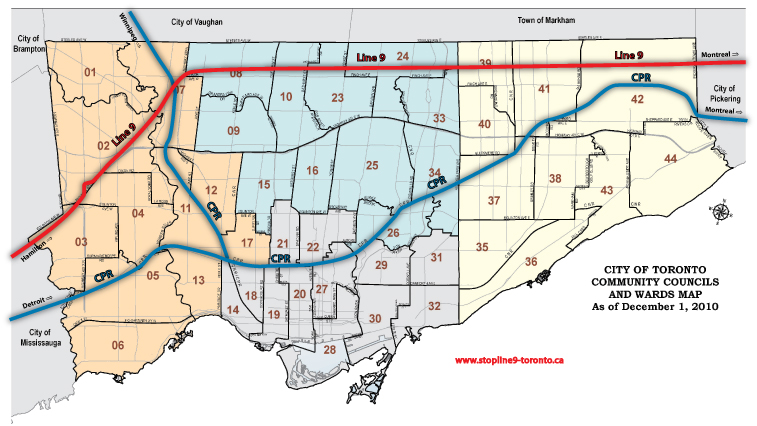
“… local governments, being the closest to the people, should be empowered to exceed, not lower, national norms.” — Supreme Court of Canada
Enbridge has completed the process of reversing the direction of its pipeline (Line 9) between Sarnia and Montreal in order to transport their Tar Sands (Diluted Bitumen) from Alberta to east coast ports for shipment around the world.
 Following the approval by the National Energy Board in 2014, and beginning in December, 2015, this has allowed Diltued Bitumen to travel through Line 9, just north of Finch Ave.
In addition to the extensive damage to the environment caused by the Albera Tar Sands, the transport of the raw material ("super-hot sandpaper") is far more susceptible to pipeline breaks and damaging spills (see PHSHA).
Not only can this toxic and corrosive mixture spread through the soil to threaten property and the water tables; it also crosses all rivers leading to Lake Ontario — the source of our drinking water. And from the time it was announced, it has become a threat to local property values.
 What Can We Do?
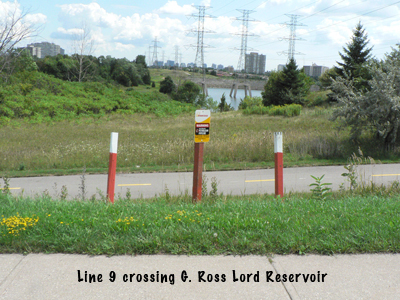
The route of Line 9 through Toronto has been marked (as shown) on sidewalks at all streets where the line crosses the city. (The Map on this site shows more detailed locations.)
We invite you and your neighbours to create a Community Action Group (CAG) to inform people in your Ward about Line 9 and what can be done to keep DilBit out of our city. If you want to start a CAG, contact us. We will supply resources, materials, and training, and connect you with others across the city.
In December 2014, Toronto's new mayor John Tory said "we should … stop movement of toxic and dangerous substances through the city."
Our goal is to motivate all city councillors to support a motion at city hall to outlaw the transport of these hazardous materials across our city. These "Unconventional Oil" products, which now includes Light Bakken Crude along with DilBit, are extremely explosive, and are solely for export.
In addition to pipelines, DilBit is also being transported by rail. The main rail-tanker route regularly used to ship these Unconventional Oils from Detroit to the east coast is through the heart of Toronto. This is the route taken by the train that exploded in Lac Mégatic on July 6, 2013.
As part of Toronto's2014 submission to the NEB, an excerpt from the Supreme Court of Canada stated that "municipalities are trustees of the environment", and that as the level of government "being closest to the people, should be empowered to exceed, not lower, the national norms". This was part of a precedent-setting 2001 decision in favour of municipal control of their cities.
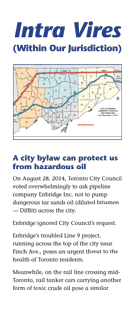
We have named our campaign to challenge the federal authority over oil pipelines and oil-by-rail, Intra Vires (Within Our Jurisdiction). But we must first create a bylaw to ban Tar Sands from the city.
 |
 |
Resources
The Resources Link lists environmental organizations which might be expected to have an interest in Line 9.
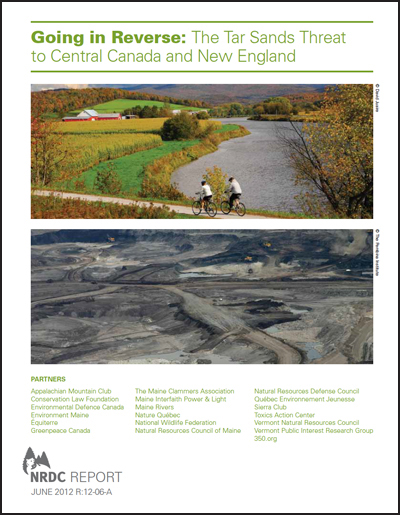
In 2012 the U.S. Natural Resources Defense Council (NRDC) printed an excellent background report prepared by U.S. and Canadian environmental organizations. "Going in Reverse: The Tar Sands Threat to Central Canada and New England" is available at right.
What's the Problem?
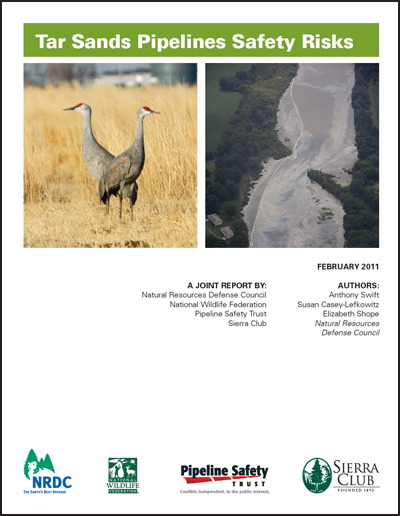
In 2011 the NRDC prepared a document called "Tar Sands Pipelines Safety Risks" which details the dangers of the Diluted Bitumen that travels through these pipelines. Included is a detailed breakdown of the chemical composition of the "DilBit":
"DilBit contains benzene, polycyclic aromatic hydrocarbons, and n-hexane; toxins that can affect the human central nervous systems. A recent report filed by the Michigan Department of Community Health found that nearly 60 percent of individuals living in the vicinity of the Kalamazoo River spill experienced respiratory, gastrointestinal, and neurological symptoms consistent with acute exposure to benzene and other petroleum related chemicals. In addition to their short term effects, long term exposure to benzene and polycyclic aromatic hydrocarbons has been known to cause cancer."
"DilBit also contains vanadium, nickel, arsenic, and other heavy metals in significantly larger quantities than occur in conventional crude. These heavy metals have a variety of toxic effects, are not biodegradable, and can accumulate in the environment to become health hazards to wildlife and people."
The Fukushima Syndrome
Despite Risk Analysis regarding the potential for disaster in any human undertaking (99% and 1% have the same consequences), the more important question is: What will be the social cost when this (pipeline/nuclear plant) fails? Given that inevitable cost, are we as a society willing to accept it in exchange for enriching energy companies?
(At the time Fukushima was built, authorities stated that there was no "known" event which could shut down the nuclear plant. The problem was the "unknown" event.)
